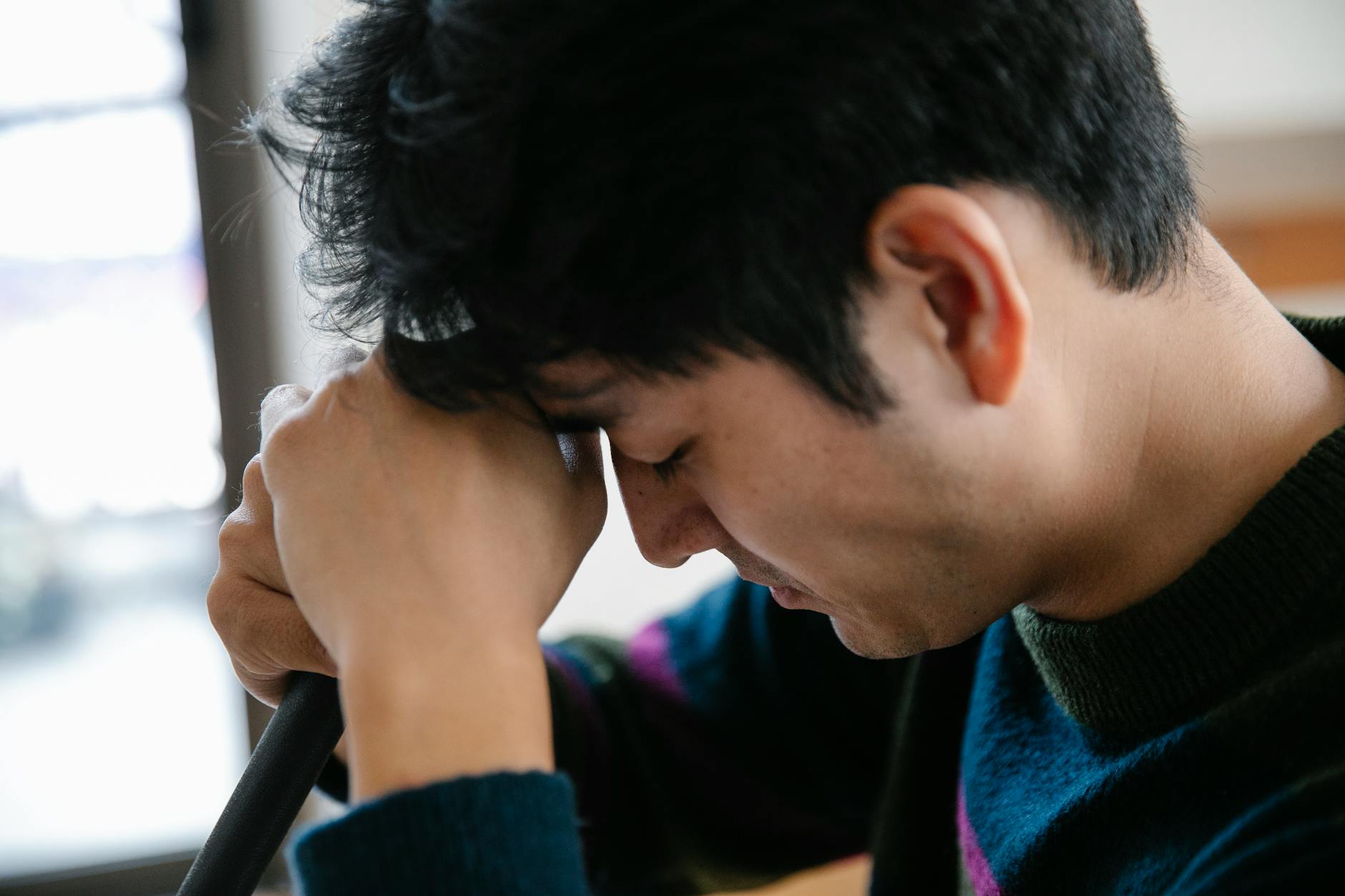
There was a time when I used to wake up in the middle of the night with my heart racing — for absolutely no reason. My chest felt tight, my breathing would get shallow, and my mind kept saying “something bad is about to happen.” There was no real danger, no actual threat, yet my entire body was reacting like I was standing in front of a lion. That was anxiety. And back then, I didn’t even have a proper name for what I was going through.
More than 300 million people around the world are going through this. Yet nobody really talks about it openly. Most people brush it off as “just stress” or “overthinking.” I did the same thing — for years.
This is not a medical guide. This is just my story. What I felt, what I tried, and what slowly started to shift things for me.
Fighting Anxiety Only Made It Worse
My first instinct whenever anxiety hit was always the same — suppress it. Push it away. Distract myself. Do anything to make it stop. But the harder I fought it, the stronger it came back.
Looking back, I was like someone stuck in quicksand. The more you struggle, the deeper you sink. Every time I tried to resist the anxiety, my body read it as a signal that something was truly dangerous — and the panic would only grow.
I once came across this idea — “What you resist, persists.” I didn’t fully understand it at first. But I lived it. Every time I treated anxiety like an enemy, it became a bigger and more powerful one.
One day, almost out of exhaustion, I tried something different. The anxiety came — and instead of fighting it, I just sat with it. No phone, no distraction, no trying to make it go away. Just 15 minutes of stillness. And something strange happened. After those 15 minutes, the intensity slowly started to fade on its own. It didn’t vanish completely, but it softened.
That was the first time I realized — the body doesn’t stay in one state forever. It just needs a little space.
The Breathing Thing Nobody Told Me
During anxiety attacks, I always felt like I couldn’t breathe. It felt suffocating, like I was running out of air. My natural response was to take deep, fast breaths — but that always made things worse.
It took me a while to understand why. During anxiety, breathing becomes short and rapid, which actually increases oxygen in the body while reducing carbon dioxide. That imbalance is what causes dizziness and that horrible suffocating feeling. More deep breathing was the last thing my body needed.
What actually helped me was focusing on the exhale — breathing out slowly and completely, almost like emptying myself. Less about filling up, more about letting go. It sounds simple, but in that moment, that small shift made a real difference.
What Anxiety Actually Was — At Least For Me
The Roman philosopher Seneca once said — “We suffer more in imagination than in reality.”
That one line described my anxiety perfectly. I was living through disasters that hadn’t happened yet. Worrying about conversations that might go wrong, situations that might fall apart, futures that existed only in my head. I was exhausting myself fighting shadows.
And then I discovered something that changed everything for me — anxiety isn’t just an emotion. It’s what happens when emotions get buried.
Every time I felt angry but stayed quiet because it seemed “immature” to show it. Every time I was sad but didn’t cry because I thought I had to stay strong. Every time I felt hurt but smiled anyway. All of that energy didn’t disappear. It didn’t go anywhere. It just stayed inside — compressing, building up — and eventually it came out as anxiety.
The headaches I couldn’t explain. The stomach issues that had no physical cause.
The restlessness I felt for no apparent reason. It was all that stored-up, unprocessed emotion looking for a way out.
Anxiety, I slowly understood, is just stuck energy. Emotions that were never allowed to move through you. And the solution was never to push them down harder — it was to finally let them flow.
The Day I Stopped Seeing Anxiety As My Enemy
Here’s something I genuinely wish someone had told me earlier — people who experience anxiety often have incredibly fast, deep-thinking minds. They feel things more intensely. They notice things others don’t. Many of the most creative, brilliant people in history dealt with intense anxiety — not despite their sensitivity, but because of it.
When that kind of energy has no outlet, it turns inward. It starts feeding on itself. But when it finds a direction — writing, music, painting, building something — it becomes something extraordinary.
The day I started writing — not for anyone else, not for an audience, just for myself — was the first day I felt genuinely lighter. That restless energy that used to show up as panic started showing up as words on a page instead. I didn’t need to kill the anxiety. I just needed to give it somewhere to go.
It wasn’t a cure. But it was a turning point.
Where I Am Now — And Why I’m Sharing This
I’m not going to pretend everything is perfect now. My mind still runs fast. I still have moments of unexplained restlessness. But my relationship with anxiety has completely changed.
The biggest shift wasn’t a technique or a breathing exercise. It was simply this — I stopped treating anxiety as proof that something was wrong with me.
Because nothing is wrong with you. A mind that feels deeply, thinks constantly, and processes the world intensely is not a broken mind. It’s a powerful one that hasn’t found its right channel yet.
The day you stop fighting your anxiety and start getting curious about it — that’s when things begin to move. Not overnight. Not in one moment. But slowly, steadily.
If you’re going through this right now, I just want you to know — you are not weak for feeling this way. You are not broken. You are not losing your mind. You are someone who feels deeply in a world that rarely makes space for that.
That sensitivity you carry — the one that makes you overthink, overanalyze, overfeel — it is also the same quality that can make you extraordinary. The same energy that shows up as anxiety can show up as art, as writing, as music, as ideas that change things.
You are not too much. You have just been carrying too much alone, for too long.
Let some of it out. Cry if you need to. Write if it helps. Create something. Move your body. Let the energy flow instead of forcing it to stay still.
The world needs people who feel deeply. It needs people who think differently. It needs people exactly like you — not in spite of your anxiety, but with everything that comes with it.
You are enough. And you are going to be okay.